Spotting a crack in a wall can trigger an instant spiral: Is the house moving? Is it dangerous? Is this going to be expensive? In Sydney, cracks are common across all kinds of homes—Federation terraces in the Inner West, brick veneers in the Hills, mid-century builds on the North Shore, and newer estates out west. But “common” doesn’t mean “ignore it”.
The key is learning what the crack is likely telling you.
Some cracks are cosmetic: paint, plaster, or minor shrinkage. They can look alarming, but often don’t signal structural trouble. Other cracks are movement-related: they’re linked to how the building is behaving—settling, expanding/contracting, responding to moisture changes in the ground, or reacting at stress points like windows and doors.
This guide helps you sort cracks into sensible buckets, understand Sydney-specific factors, monitor changes properly, and avoid the classic mistake: patching a symptom while the cause keeps doing its thing.
First principles: what makes a crack “hairline” vs “structural”?
Hairline cracking
Hairline cracks are usually thin, shallow, and often limited to the surface layer (paint, plaster, render topcoat). They’re commonly caused by:
• Normal building settlement in the early years of a home
• Shrinkage as plaster compounds dry
• Temperature and humidity cycles
• Minor movement at junctions (cornices, plasterboard joins)
• Vibration and everyday building “life”
Hairline does not automatically mean harmless—especially if moisture is involved—but it often points to a finish-layer issue rather than a load-bearing problem.
Structural cracking
Structural cracks suggest that part of the building (or the substrate behind a finish) is moving in a way that may affect integrity, performance, or safety. Structural cracking is more likely when you see:
• Cracks that widen over time
• A pattern associated with movement (stair-step in masonry, diagonal from openings, long horizontal cracks)
• Cracking combined with functional changes (doors sticking, windows binding, uneven floors)
• Repeated cracking in the same spot after repairs
• Evidence of water ingress alongside cracking
A crack becomes more “structural” not just by its appearance, but by its behaviour and context.
Q&A: Are hairline cracks in walls normal in Sydney homes?
Hairline cracks can be common in Sydney homes, especially in plaster, around cornices, and at junctions where materials meet. What matters is whether the crack is stable and whether there are other signs like moisture, rapid change, repeated recurrence after patching, or doors/windows starting to stick. Stable hairlines are often cosmetic; changing cracks deserve closer attention.
Sydney realities: why cracks can be common here
Sydney’s built environment and climate create a few recurring drivers that can influence cracking:
• Weather cycles: hot spells, cool nights, humid stretches, and storm periods can drive expansion/contraction and moisture movement in materials
• Renovations and additions: lots of Sydney housing stock has been altered over decades, creating new-to-old junctions that move differently
• Varied ground conditions: some areas are more prone to seasonal ground moisture change, which can influence foundation movement
• Exposure differences: a west-facing wall in Penrith copes with a different thermal load than a shaded side wall in a leafy lower North Shore street
• Drainage and stormwater: concentrated water near footings (downpipes, poor falls, blocked drains) can amplify movement risks
You don’t need to diagnose soil mechanics to be practical as a homeowner. You just need to recognise when a crack is consistent with normal finishing behaviour—and when it looks more like a movement story.
Crack patterns and what they often mean
Instead of obsessing over the crack’s existence, look at four things:
• Location (near openings? corners? mid-wall? ceiling line?)
• Direction (vertical? diagonal? stepped? horizontal?)
• Depth (surface-only? does it run through substrate?)
• Change over time (stable? widening? multiplying?)
1) Fine cracks at cornices and plasterboard joins
These often appear as straight lines near ceilings, at internal corners, or where plasterboard sheets join.
Common causes:
• Minor movement at joints
• Settlement and seasonal changes
• Shrinkage of joint compound
• Poor joint finishing or insufficient reinforcement tape
What it often suggests:
Usually cosmetic. It’s frustrating, but it’s often a finishing detail issue rather than structural distress—unless it’s paired with widespread new cracking or clear movement symptoms elsewhere.
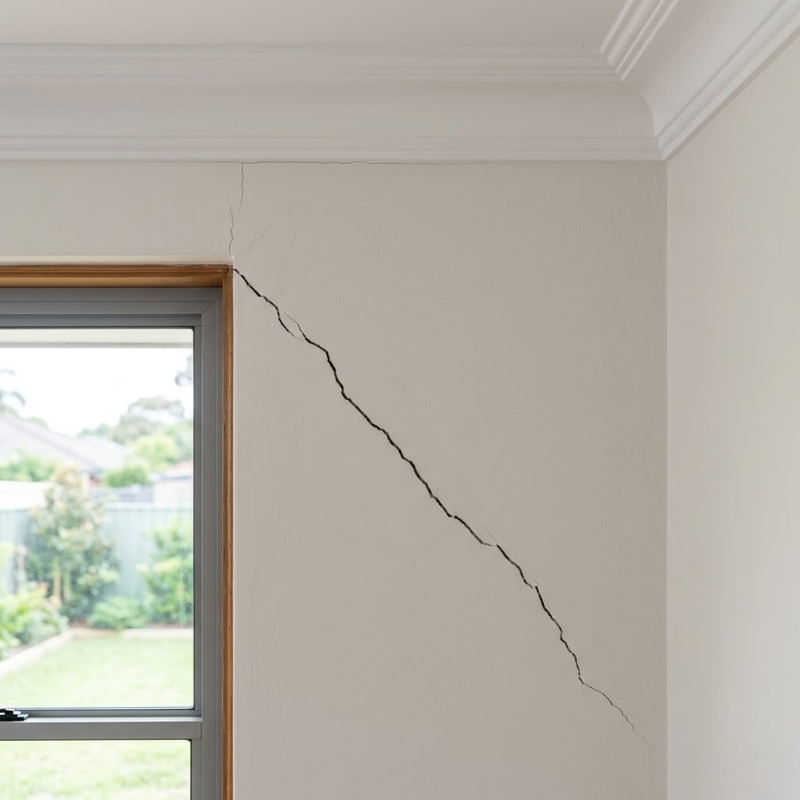
2) Diagonal cracks from the window and door corners
Diagonal cracking at openings is one of the most important patterns to take seriously—especially if it grows.
Common causes:
• Stress concentration around openings (corners are natural weak points)
• Movement in the wall or supporting elements (including lintels)
• Differential movement between materials (brickwork, render, plaster, frames)
What it often suggests:
Not always structural failure, but definitely “monitor and assess.” Openings reveal movement early. If the crack is widening, recurring quickly after repair, or combined with sticking windows/doors, it moves up the priority list.
Q&A: Why do diagonal cracks form near windows and doors?
Openings interrupt the wall’s strength and create stress points at corners. Small movements from settlement, thermal expansion, or changes in load distribution often show up as diagonal cracks radiating from those corners. A small, stable diagonal crack can be cosmetic; a crack that grows, reappears quickly, or comes with sticking doors/windows suggests movement that needs attention before cosmetic repairs.
3) Stair-step cracks in brickwork (or cracks that “trace” brick lines)
These appear as stepped lines that follow mortar joints, often visible through paint or render.
Common causes:
• Movement in masonry (settlement, footing movement, or differential movement)
• Localised stress near corners and openings
• Moisture changes around foundations contribute to movement in some cases
What it often suggests:
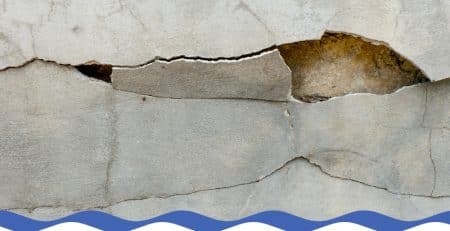
A higher likelihood that the wall substrate is cracking, not just the surface finish. That doesn’t automatically mean unsafe—but it does mean patching the surface alone may be short-lived unless the movement driver is addressed.
4) Long vertical cracks
Vertical cracks can be cosmetic or movement-related, depending on where they appear and whether they change.
Common causes:
• Shrinkage cracks in plaster finishes
• Movement at a junction between different materials
• Building movement concentrating on a weak line
• Old repairs “printing through”
What it often suggests:
If it’s thin, stable, and surface-only, it may be cosmetic. If it aligns with a structural change or grows, it may indicate differential movement.
5) Horizontal cracks
Horizontal cracking can be more concerning, especially if it’s long, widening, or located at consistent heights.
Common causes:
• Movement at structural transitions
• Differential movement between wall sections
• Corrosion expansion in some assemblies (less common, but possible where steel is involved)
• Poor detailing at junctions
What it often suggests:
Often worth investigating earlier than later, particularly if it’s widening or paired with other symptoms.
The “behaviour test”: what makes a crack more urgent?
A crack’s urgency comes from what it’s doing, not just what it looks like on one day.
Changes that matter
Watch for:
• The crack gets wider (not just longer)
• New cracks appear nearby
• The crack starts branching like a “tree”
• Cracking appears on both sides of a wall (internal and external alignment can matter)
• Repairs fail quickly in the same place
Clues that the building is moving
These are the “combo signals” that raise concern:
• Doors or windows that start sticking or going out of square
• Gaps opening at skirtings, architraves, or between wall and ceiling
• Tiles cracking or popping
• Floors feel uneven where they previously didn’t
• A cluster of new cracks appeared around the same time
One symptom alone can be benign. Multiple symptoms together are a stronger signal to assess movement drivers.
Q&A: What size crack should I worry about?
There isn’t a single magic number that applies to every wall and every material. What matters more is whether the crack is changing, whether it matches higher-risk patterns (stair-step, diagonal from openings, long horizontal), and whether it’s paired with functional changes or moisture. A thin crack that stays the same can be less concerning than a “small” crack that keeps growing.
Moisture: the overlooked crack multiplier
Moisture can be both a cause and a consequence of cracking:
• Water can weaken finishes and substrates, making cracks more likely
• Cracks can become entry points for wind-driven rain, especially on exposed walls
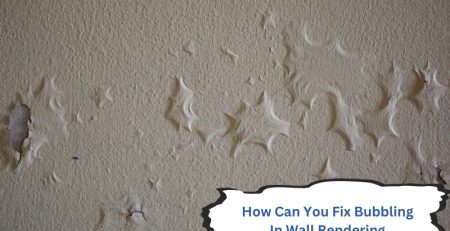
• Persistent damp can lead to paint bubbling, mould, salt deposits, and degradation over time
Sydney conditions that can contribute:
• Leaking gutters or overflowing downpipes
• Poor falls that direct water toward the house
• Garden beds or paving too high against walls
• Blocked stormwater systems
• Sealant failures around windows and penetrations
If you see cracking plus moisture symptoms, treat it as more urgent than cracking alone.
Signs that moisture is involved
Look for:
• Bubbling or peeling paint near the crack
• Damp patches that darken after rain
• Musty smells indoors on the same wall line
• White powdery residue (often salt deposits)
• Mould growth that keeps returning in the same area
How to monitor cracks at home without fancy tools
Monitoring is one of the most useful homeowner actions—because it turns worry into evidence.
A simple crack tracking method
Over 2–8 weeks (longer if changes are seasonal):
• Take a clear photo from the same angle and distance each time
• Include a ruler or coin for scale
• Date your photos (your phone does this, but also note it in a folder name)
• Note weather events (big rain, heatwaves, long humid stretches)
• Mark the crack ends lightly in pencil (if appropriate) to see if it grows
If you want to be extra methodical, you can sketch the crack location on a simple floor plan and record dates when you notice changes.
When monitoring isn’t enough
Skip “wait and see” if:
• The crack changes rapidly over days or weeks
• Multiple new cracks are appearing suddenly
• You suspect water is entering the wall system
• Doors/windows are sticking or shifting noticeably
• The crack is accompanied by visible wall bulging or separation
Q&A: Why do cracks come back after patching?
Cracks often reappear because the underlying driver is still present. If movement is ongoing, a rigid patch can crack again. If moisture is involved, it can weaken the repair and the surrounding area. And if preparation is rushed (surface fill without cleaning/opening/bonding properly), the repair may only bridge the top of the crack rather than stabilise it.
Cosmetic cracks you can usually treat as “low drama”
These are commonly less urgent—assuming they’re stable and moisture isn’t part of the story:
• Hairline cracks in paint or plaster that don’t change
• Fine lines at cornices or plasterboard joins
• Small cracks at junctions where two materials meet (with no growth)
• Minor cracking that appears after a new build settles, then stabilises
That doesn’t mean ignore them forever. It means you can prioritise monitoring, maintenance, and appropriate repair approaches instead of panic.
If you’re collecting evidence, documenting patterns, or preparing to address recurring cracks properly, it helps to understand the broader categories of causes and repair approaches found in wall crack repairs.
Cracks that deserve faster attention
These patterns and situations are more likely to be movement-related or to have consequences if ignored:
• Stair-step cracking in masonry
• Diagonal cracks at openings that grow or recur quickly
• Long horizontal cracks, especially if widening
• Cracking that aligns internally and externally in the same area
• Cracks paired with sticking doors/windows or other movement clues
• Cracking plus moisture indicators (dampness, bubbling paint, salt deposits)
This is where “what matters” becomes less about making the wall look perfect and more about preventing repeat failure or bigger damage.
Sydney scenarios: what crack behaviour can suggest
Scenario: cracks worsen after long wet periods
If cracks seem more visible after rain, or damp patches appear near them, moisture may be part of the mechanism. Water can soften some materials, alter ground moisture near footings, and create conditions where movement or surface breakdown is more obvious.
Useful homeowner checks:
• Downpipes and stormwater flow (especially after storms)
• Garden irrigation hitting the same wall line
• Ground levels and drainage falls
Scenario: cracks show most on west-facing walls in summer
Strong afternoon sun drives thermal expansion. Over time, repeated expansion/contraction can expose weakness at joints, around openings, or in finishes. Fine cracking can be cosmetic, but growth and recurrence point to stress that isn’t being accommodated well.
Scenario: Cracking appears near a renovation join
Sydney homes often have extensions or alterations. New-to-old connections can move differently, which can translate into cracks exactly where the two sections meet. That’s not automatically a disaster—but it’s a strong clue about the cause.
Q&A: Should I patch a crack straight away?
If the crack is new, it’s usually smart to monitor briefly first—unless there are red flags like rapid widening, moisture symptoms, or functional changes (sticking doors/windows). Patching too early can hide useful clues and lead to repeat repairs if the underlying driver hasn’t stabilised.
Expectations and guidance: what’s “reasonable” vs “needs action”?
Homeowners often ask what’s acceptable workmanship or normal movement. A general reference many NSW homeowners check for context is the NSW Guide to Standards and Tolerances, which outlines common concepts around building defects and tolerances in residential construction.
It’s not a substitute for diagnosis, but it can help you frame conversations and expectations—particularly when deciding whether something is minor finishing work or something that needs deeper assessment.
A practical next-step decision path
If you want a calm, sensible approach:
• Identify the pattern (hairline at join, diagonal at opening, stair-step masonry, horizontal, etc.)
• Check for moisture clues
• Check for movement clues (doors/windows, multiple cracks, rapid change)
• Monitor with photos and dates if it seems stable
• If it’s changing, recurring, or paired with moisture/movement signs, prioritise assessment before cosmetic repair
If you’re trying to work out the best way to handle a recurring crack (especially when patching hasn’t lasted), the overview information on underwall crack repairs in Sydney can help you understand why some cracks need more than a surface fix.
FAQs
Are hairline cracks always cosmetic?
Not always, but many hairline cracks are cosmetic—especially if they’re stable and not linked to moisture. A hairline crack that grows, returns quickly after repair, or appears alongside movement signs is more likely to be part of a bigger issue.
What crack patterns are most associated with movement?
Stair-step cracks in brickwork, diagonal cracks from window/door corners that change over time, and long horizontal cracks are more commonly linked with movement than fine plaster hairlines.
How long should I monitor a crack?
If there are no red flags, 2–8 weeks of monitoring with dated photos can be enough to confirm whether a crack is stable. In some cases, seasonal change matters—so if you suspect weather is influencing it, longer monitoring can help.
What if a crack only appears (or looks worse) after rain?
That can suggest moisture is involved—either entering through the crack or affecting the wall/ground moisture conditions. Check drainage, downpipes, sealant points, and damp symptoms indoors.
Can painting over cracks solve the problem?
Paint can hide a crack temporarily, but it rarely solves an underlying cause. If movement or moisture is driving the crack, it will typically return. Proper preparation and the right repair approach matter.
Do I need to worry if doors and windows start sticking?
Sticking doors/windows alongside cracking can be a sign of movement. One stuck door alone isn’t proof, but the combination is worth taking seriously—especially if changes are recent.
Why do cracks keep coming back in the same spot?
Because the same stress is still present—movement at a junction, ongoing moisture, or inadequate preparation and repair method. Repeated recurrence is a strong clue that a deeper approach is needed.
What’s a sensible next step if I’m unsure?
Document the crack (photos with scale and dates), check for moisture and movement clues, and avoid repeated surface patching until you’re confident about the driver. If you want a clear framework for the types of causes and repair approaches, start with a plain-English overview like wall crack assessment.