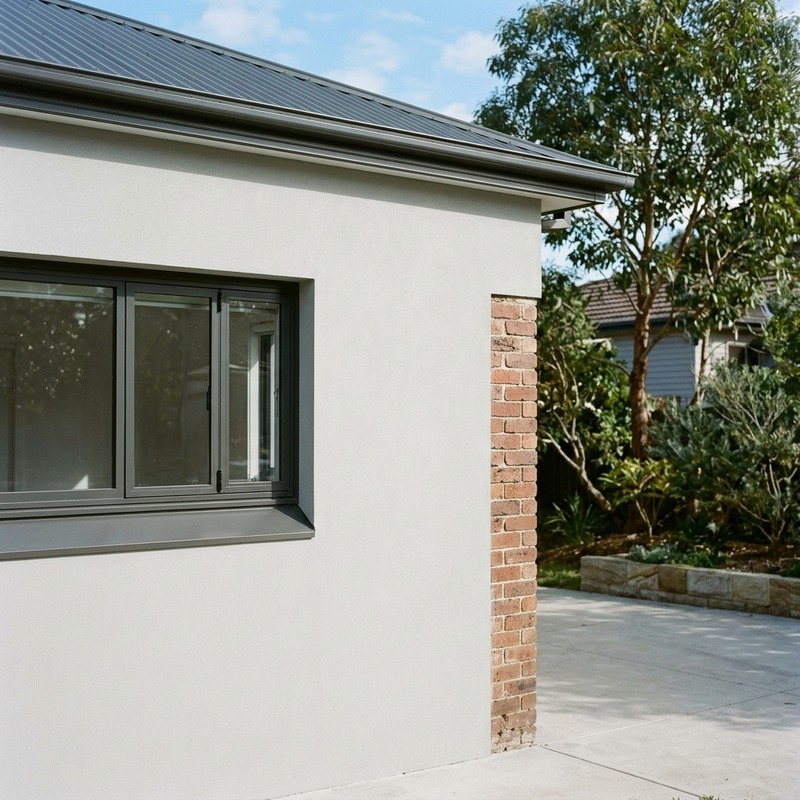
What is render in construction? Render is a thin coating of mortar, usually a mix of cement, lime and sand or an acrylic-based equivalent, applied to the outside face of a masonry wall to protect it from the weather and give it a consistent finish. That is the whole idea in one sentence. In practice there is more to it, because the word covers several materials doing slightly different jobs, and the version on a 1920s brick cottage is not the version on a new apartment block. I have written this as a plain explanation rather than a technical one, so a quote full of unfamiliar terms becomes readable. Most rendering work on Sydney homes falls into one of a handful of categories, which the sections below set out.
What render actually is
Render is a surface coating, not a structural element. It is applied wet and trowelled onto a wall in one or more coats, and when it cures it becomes a hard shell bonded to the masonry underneath. A typical coat is between about 5 and 20 millimetres thick, depending on the system and how much levelling the wall needs.
The key distinction is that render does not hold anything up. The brick, block or concrete behind it carries the load. Render takes the weather, evens out the surface and sets the appearance, which is why it can be replaced decades later without touching the structure. When people ask what render is in construction, that is the useful answer: a renewable outer layer that wears out so the wall behind it does not.
What render is made from
A traditional mix has three parts. Sand gives body and controls the texture, cement provides strength, and lime brings workability plus the flexibility that helps the coat take small movement without cracking. Proportions change with the coat: base coats are stronger and coarser, finish coats finer and weaker, because a finish coat harder than the one beneath it will crack.
Modern mixes add polymers to improve adhesion, water resistance and flexibility. Acrylic-based products go further, replacing much of the cement binder with an acrylic polymer to give a thinner, more flexible coat that will go over surfaces a cement mix would struggle with. Pre-bagged products are now the norm, because a factory blend is consistent in a way a site mix is not.
One rule holds across all of them: the coat must be no stronger than what it is stuck to. A hard coat on a soft old brick wall is a classic failure, because the wall moves and the coating will not.
What render is for
Four jobs, roughly in order of importance.
- Weather protection. The coat sheds rain and takes the UV, salt and wind that would work away at the mortar joints and the brick face.
- Moisture management. A well-chosen system keeps liquid water out while letting vapour pass out of the wall, which stops damp from being sealed in.
- Appearance. It turns a patchwork of brick, block and old repairs into one clean plane.
- Surface durability. A dense coat resists knocks better than soft brick, and it can be renewed without disturbing the wall behind.
The main types you will come across
Four categories cover most of what gets specified on a residential job.
Cement-based render is the traditional sand, cement and lime coat. It is hard, dense and has real body, so it levels an uneven wall well and takes paint over the top. Acrylic render is thinner and more flexible, bonds to a wider range of surfaces including painted and smooth ones, and goes on in fewer millimetres. Texture coating is a thick, pre coloured product supplying both the surface pattern and the colour in one application. Lime render, without cement, is soft and highly breathable, and suits older solid masonry built to breathe.
Each is the right answer in different circumstances, suited to different substrates and exposures rather than better or worse than the others.
Where cladding systems fit in
Some wall systems use render as the outer skin over an insulating board rather than over masonry. A foam board is fixed to the frame, a reinforcing mesh is embedded in a base coat over it, and a finish coat completes the surface. The look is a rendered wall, but the construction is different, because the insulation and the weather barrier are part of the one assembly.
The polystyrene cladding systems of this kind are common on new builds and extensions, where thermal performance does as much work as appearance. They bring their own detailing and fire performance considerations, which is why the National Construction Code, published by the Australian Building Codes Board, sets requirements for external wall systems containing combustible components. Those requirements have been revised more than once in recent years, so confirm the current position with that body rather than relying on older guidance.
Render and plaster are not the same thing
The two words get used interchangeably, and they should not be. The simplest way to keep them apart is where they go. Render is the external coating, mixed to survive weather and built around cement or acrylic binders. Plaster is the internal equivalent, usually gypsum-based, mixed for a smooth paintable finish and not expected to handle rain.
Terminology varies by region, but in Australian practice render means the outside of the building and plaster means the inside, or plasterboard sheeting.
How long render lasts
A well-applied coat on a sound wall has a long service life. Cement-based systems commonly run 20 to 30 years or more before needing significant work, and lime renders on heritage buildings have lasted a great deal longer. Acrylic systems and texture coatings sit in a similar range when maintained, though a coloured finish layer may want refreshing sooner than the body of the coat.
What shortens it is almost never the material. It is water getting in where it should not, movement in the structure below, or a coat applied to a surface it could not bond to. Blocked weep holes, failed flashings and a downpipe discharging onto the finish do more damage over time than weather alone.
Maintenance is modest. Wash the walls occasionally, keep plants and sprinklers off them, clear the drainage paths, and have hairline cracking looked at before it opens up.
Who is allowed to do the work?
In New South Wales, residential building work above a set value must be carried out by an appropriately licensed person, with the thresholds and licence categories administered by NSW Fair Trading. The work has to meet the National Construction Code and the Australian Standards it calls up, published through the Australian Building Codes Board. Both are updated periodically, so check the current requirements with those bodies before work starts.
Frequently asked questions
What is cement render?
Cement render is the traditional external coating made from sand, cement and usually lime, mixed with water and trowelled onto masonry in one or more coats. It cures to a hard, dense shell that protects the wall from the weather, levels out an uneven surface and provides a base for paint or a coating. It is the most common form of render on brick and block walls.
What is the purpose of rendering a wall?
Mainly protection. The coat sheds rain and takes the sun, salt and wind that would otherwise erode the mortar joints and the brick face. It also manages moisture, keeping liquid water out while letting vapour escape, evens an irregular wall into a single clean surface, and improves resistance to knocks and abrasion.
What is the difference between render and plaster?
Render goes on the outside, and plaster goes on the inside. Render is cement- or acrylic-based and mixed to handle weather. Plaster is usually gypsum-based and mixed for a smooth internal finish that will be painted. In Australia, plaster also commonly refers to the plasterboard sheeting used to line internal walls and ceilings.
How long does render last?
A well-applied coat on a sound wall typically lasts 20 to 30 years or more before it needs significant attention, and lime renders on older buildings have lasted much longer. Lifespan depends far more on keeping water out and on the condition of the wall behind than on the material itself, so drainage, flashings and early crack repair matter most.
Working out what your own walls need
If you are trying to work out what your own walls need, Jims Rendering Sydney has spent more than 15 years on Sydney buildings and our licensed team is happy to explain the options in plain terms. You can contact us for a look at the wall.