How Long Does Rendering Take on a Sydney Home?
When you ask how long rendering takes, you are almost never just curious. You are trying to plan a sale, a family event, a tenancy change, or a run of other trades you need to slot this around. The honest answer is that it depends on the house, but that is not the unhelpful answer it sounds like, because while the duration varies, the sequence is predictable, and the things that move a timeline are mostly knowable before anyone picks up a trowel. This article walks through the stages in order, explains what controls the pace of each, and tells you what to ask so you end up with a real schedule rather than a guess. A firm timeline, though, only comes from an on-site inspection.
The stages of a render job, in order
A render job on a Sydney home follows a set path, and knowing the order helps you picture where the time goes. Our published process runs as a quick call to take your details, an on-site inspection, a fixed on-site quote, proper preparation, render and finish, then clean-up and a walkthrough at the end. For a cement render specifically, the sequence on site runs inspection, preparation, bonding and priming, render application, then finishing and curing.
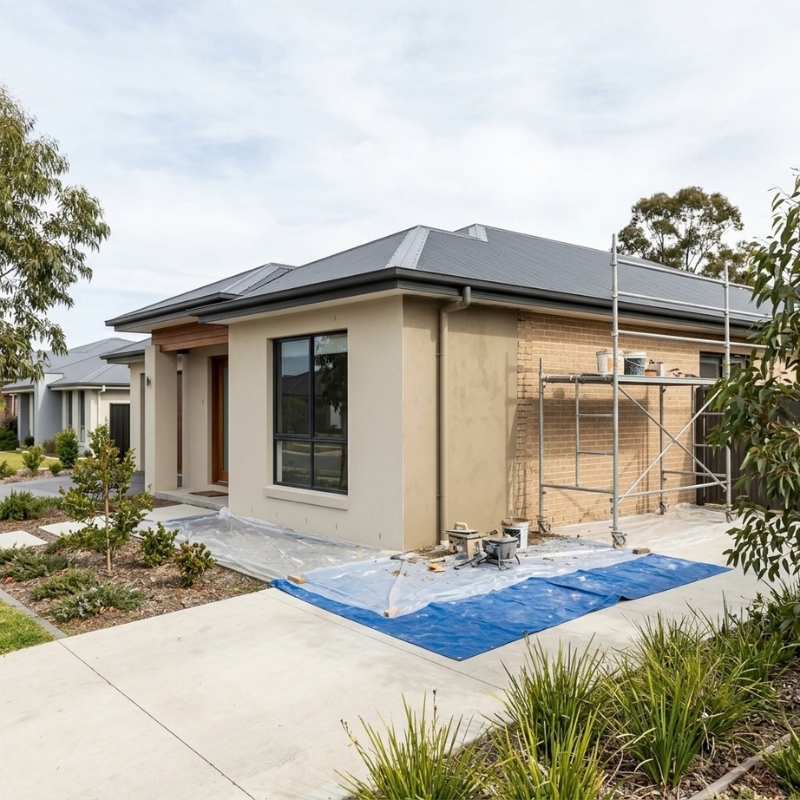
Here is what you would actually see. First, the site gets set up: access is arranged to reach the walls, and surfaces, windows, paths and anything nearby are protected so they come through clean. Then the wall itself is prepared, cleaned and made ready, and primed so the render has something to grip. Only then do the coats go on, and finally the chosen finish is worked into the surface.
The point worth making plainly is that the preparation and set-up are a genuine part of the programme, not a delay before the real work starts. A wall that is properly prepared is what lets the render bond and last, and the jobs that skip this stage are the ones that come back with problems. So when you are looking at a rendering timeline, count the preparation in rather than treating it as dead time, because it is doing the work that makes everything after it hold.
What makes one job longer than another
This is the part that actually answers your question, because the variables here are what decide whether a job is quick or drawn out. The main ones are:
- The size of the wall area and how many elevations are in scope. A single wall is a different job from all four sides of the house.
- Access. A single-storey wall you can reach from the ground is quicker to set up than an upper level that needs scaffolding, and a narrow side boundary slows everything down because there is less room to work and move materials.
- The condition of the existing surface and how much preparation it needs. A sound wall is ready sooner than one that needs work first. A wall with cracking, for example, needs proper wall crack repairs Sydney before any render goes on, which adds a whole stage to the front of the job, and the same goes for stripping back a failed coating.
- Whether the substrate is masonry or framed sheeting. The two are prepared differently, so the surface you are rendering onto changes the approach.
- The finish you choose. A textured or bagged finish is worked differently from a smooth one, so the finishing stage is not the same on every job.
- Whether the job runs continuously or has to work around other trades. A clear run is faster than a job that has to pause and return.
When people ask how long to render a house, the honest answer is that the single biggest variable is usually preparation, and preparation is exactly the part a quote based on a photograph gets wrong. You cannot judge the condition of a wall properly until you are standing at it.
Why render drying time controls the programme
There is one constraint on a render job that no one can negotiate away, and it is worth understanding because it sets the pace of everything. Render is applied in coats, and each coat has to be properly set before the next one goes on. The finish cannot be worked until the surface underneath is ready to take it.
This is a material process, not a scheduling preference. It is the render itself curing and hardening, and pushing it before it is ready does not save time; it causes cracking and poor adhesion, which means doing the job again. So render drying time is not a delay someone has added to the quote; it is the material doing what it has to do. The same physical reality governs how long between render coats on any job, including a cement rendering Sydney project, where the coats and their setting are central to the result.
What sets the pace of that setting is the weather and the wall. Temperature, humidity, sun and wind on a particular elevation all change how a coat sets, which is why the very same house can move at a different pace in February than it does in July. A renderer who promises a fixed turnaround regardless of the conditions is promising something the material simply does not allow.
How Sydney weather affects the schedule
Sydney’s weather has a direct say in a render programme, and it is worth knowing where it bites. Rain is the obvious one: it stops application and can damage fresh work, so a wet week pushes a programme no matter how well it was planned. Summer heat and strong sun on a west-facing wall can make a surface set too fast to work properly, which is why hot-weather work often means early starts or shading the wall rather than pressing on and ruining the finish. High humidity slows setting down. And the coastal wind that reaches the eastern and northern suburbs affects both the application and any scaffolding that is up.
The practical takeaway is that weather delays rendering, and a sensible programme is planned with some tolerance built into it. A renderer who builds in no contingency at all will either rush the work when conditions turn or miss the date they gave you. It is also why there is a best time of year to render in Sydney, something we talk through at the inspection so the job is timed to work with the conditions rather than against them.
Planning the job around your household
Beyond the trade questions, you are probably wondering what living alongside the work actually looks like. It helps to know in advance which parts of the house become hard to reach and when, so you can plan around them. Before the team arrives, it is worth moving or protecting anything close to the walls, outdoor furniture, pots, the car, and clearing space so the team has access and somewhere for materials to sit.
Between stages, the site will look like a work in progress, with access equipment in place and walls at different points. The reassuring part is that a larger job can be handled by rendering a house in stages, working one elevation at a time, so the whole house is not a worksite all at once, and you keep the use of the rest of it. Where a schedule genuinely demands it, we also offer after-hours work.
The thing to do is ask at the inspection for the actual plan: which stages, in what order, and what happens if the weather turns. That gives you a programme you can organise your household around rather than a vague sense of upheaval.
Getting a real timeline for your home
A dependable timeline comes from someone standing at your wall, and the reason is simple: access, the condition of the substrate and the amount of preparation are the variables that decide the schedule, and all three are assessed on site rather than guessed from a description. This is why professional house rendering Sydney starts with an inspection rather than a number over the phone.
Our process is straightforward. A quick call takes your details, then an on-site inspection lets us see the walls, the access and the preparation involved, and from that you get a fixed quote with the scope set out before any work starts, so you know exactly what is being done. Quotes are free, carried out on site, and come with no obligation, and our licensed team works Sydney-wide. So the real answer to how long rendering takes for your home is the one worked out at your wall, where every variable that matters can actually be seen.
Rendering is predictable in its sequence even when its duration is not, and that duration is set by the house, the preparation it needs and the weather the job runs through. If you are ready to get a programme set for your own home, book a free on-site quote and we will come to you anywhere across Sydney.