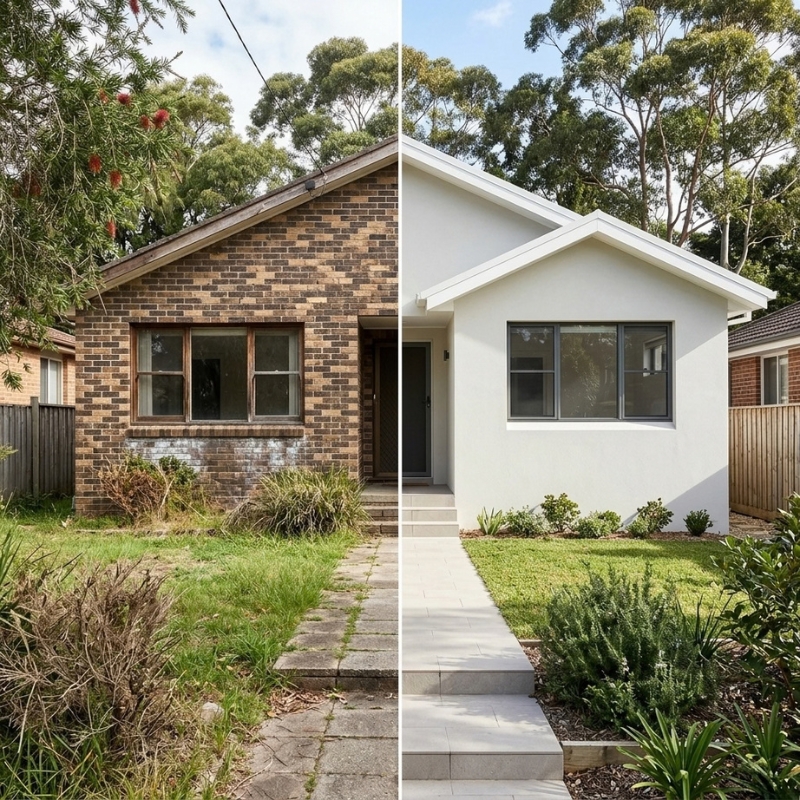
Rendered House Before and After: Sydney Transformations
You know the house. Solid, well-built, nothing actually wrong with it, but the brick or sheeted exterior looks tired from the street and makes the whole place read as older than it is. Rendering changes that, because it changes the surface, the shadow lines and the colour of a facade in a single job. What surprises most people is that the bulk of the visual gain comes from the preparation and the detailing rather than from the render itself. Over 15+ years working across Sydney, we have seen the same thing again and again. This article walks through real rendered house before-and-after transformations, explains what drove the change in each, and helps you judge whether your own home would benefit.
What actually changes when a house is rendered
To make sense of the photos, it helps to understand what your eye is actually responding to. A brick wall is made of many small units with mortar lines running between them, and all those lines are visual noise. Render turns that into one continuous plane, and the noise disappears, so the wall reads as calm and deliberate.
Colour changes too. Brick is mottled, varying from unit to unit, while a rendered surface takes an even, uniform colour across the whole wall. Shadow behaves differently as well, because a flatter surface catches light more evenly, which makes the building read as larger and more intentional than the broken-up brick did. And the edges sharpen: window reveals, corners and junctions become crisp straight lines instead of stepped brickwork.
Put together, that is the render transformation people are reacting to when they say a rendered home looks modern. It is worth being honest about one thing, though: render changes the surface, not the shape. It does not alter the proportions or the form of the house, so a result looks its best when the existing proportions are already good. A well-shaped home with a dated surface is exactly where render does its most convincing work.
Before and after: a rendered brick home
Picture a typical older brick home as you would see it from the footpath. The brick colour is patchy, the mortar lines dominate the whole facade, and previous repairs show as mismatched patches where bricks or mortar were replaced over the years. Sometimes the brick has been painted at some point, and the paint has gone chalky and uneven. It is a surface carrying decades of small, visible history.
Most of what makes the after result work is never visible in the after photo. Before any finish goes on, the substrate is checked, any existing cracking is dealt with, damaged mortar or old render is made good, and the wall is primed so the new finish keys properly to it. That invisible groundwork is what the final result rests on.
Then the finish goes on, and the change is plain: a continuous surface in place of the busy brick, even colour instead of mottled patches, and sharp edges at the reveals and corners. This is a clear before-and-after rendering result on a rendered brick home. The finish itself can be smooth, textured or bagged, and each suits a different look, which is why the choice is made for the particular house rather than by default. A cement rendering Sydney finish is one of the options we work with here.
Before and after: a sheeted addition brought into line with the original house
Here is a different kind of transformation, and one homeowners underestimate most. Picture a home where an addition or an upper floor was built in sheeting while the original was brick. The two halves never matched: two different surfaces, two different colours, and a visible seam running where the old work meets the new. People often assume this mismatch is simply permanent.
It is not, but it is the technical heart of the job. The two substrates need different preparation, because a framed sheeted wall and a solid masonry wall behave differently. A sheeted wall is built on a frame and moves differently from brick, so the joints need reinforcing and the render system has to suit each surface rather than treating them as the same thing. Get that right, and the two walls can carry one continuous finish.
The result is a single facade where the join between old and new is no longer readable at all. Standing at the footpath, you would not know the house was ever two materials. That is the rendering house before and after that changes how people feel about an addition they had quietly accepted as a compromise.
Why two rendered homes can look very different
If you look at enough finished work, you notice that some rendered homes look sharp and others look ordinary, and the difference is rarely the render itself. A few things separate the two.
- How straight and true the substrate was to begin with, and whether it was corrected rather than just covered.
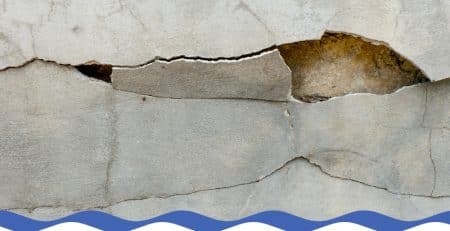
- Whether existing cracking was properly diagnosed and repaired; a crack that is covered rather than understood tends to reappear, which is why wall crack repairs Sydney are dealt with before the finish goes on, not painted over.
- How clean the edges are at reveals, corners and ground level, because the eye reads edges first, and a crisp edge is what makes the whole wall look resolved.
- Whether the finish chosen suits the house and the light it actually gets.
- Whether the colour was chosen for the wall’s orientation, since a south-facing wall and a west-facing wall show the very same colour quite differently through the day.
So what rendering looks like finished depends heavily on decisions made before and during the work, not just on the product. The honest point is this: the cheapest quote and the dearest one usually differ most in preparation, and preparation is exactly what you cannot see in the finished photograph. The right scope for your home is established on site and quoted as a fixed price.
Would your home look better rendered
You can get a fair sense of whether your home is a good candidate just by looking at it. Ask yourself:
- Is your brickwork patchy, previously painted, or carrying mismatched repairs?
- Do you have walls of two different materials that never matched?
- Is there existing cracking you have been living with?
- Are your window reveals and corners stepped and visually busy?
- Is the house structurally sound but simply dated on the outside?
If several of those ring true, your home is likely a strong candidate. A sound, well-proportioned house with a tired surface is exactly the sort of home that gains the most from rendering. The one caveat worth stating plainly is that a wall with active cracking needs the cause dealt with first, because no finish should go over a problem that is still moving.
When you are ready to find out, professional house rendering Sydney starts with a simple process: a quick call to take your details, an on-site inspection, then a fixed on-site quote with the scope set out before any work begins, followed by proper preparation, the render and finish, and a clean-up and walkthrough at the end. Quotes are free, done on site and carry no obligation, and our licensed team works Sydney-wide.
The visible result you see in a finished photo comes almost entirely from the invisible preparation behind it, which is the real story of every rendered house before and after. If your home is sound but looking tired, book a free on-site quote, and we will come and look at it with you, anywhere across Sydney.